What could 5,572% keyword growth do for your business?
Building Organic Traffic Growth from the Ground Up
When this project began, the client’s website offered a predictive risk assessment tool for expectant mothers: a valuable solution, but one that generated very little search demand. The challenge wasn’t simply to improve organic traffic; it was to build an SEO strategy capable of helping the business reach more people through unpaid search engine results while establishing long-term authority.
Without relying on paid link building, every decision centered on sustainable organic growth that would continue delivering qualified visitors long after implementation.
Website and SEO Strategy Focused on Sustainable Organic Growth
Rather than chasing highly competitive head terms, the strategy was built around extensive keyword research and competitive analysis. Every piece of content was created using real ranking data, ensuring each page targeted the right keywords while matching user search intent.
The strategy combined advanced technical SEO with content optimization to help search engines better understand the site’s information and topical relevance. An avalanche-style approach allowed the site to win attainable keyword opportunities first, building authority before expanding into more competitive terms.
- Comprehensive competitor-driven content briefs
- Advanced schema markup across key pages
- Strategic keyword targeting based on achievable opportunities
- Continuous optimization to increase organic visibility over time
This methodology steadily improved organic rankings while expanding the site’s overall topical authority.
Results at a Glance
Using High-Quality Content to Drive Organic Traffic
A major component of the campaign focused on creating high-quality content that answered the exact questions people were asking throughout the customer journey.
Rather than publishing articles based on assumptions, every page was built using competitive SEO data and search intent analysis. FAQ sections were created directly from Google’s People Also Ask results, giving the website additional opportunities to appear throughout the SERP and drive more organic search traffic.
This strategy produced measurable visibility beyond traditional organic rankings:
- 9,874 keywords now trigger a People Also Ask result.
- 4,372 keywords generate an AI Overview citation.
- The site earned a Google Knowledge Panel, strengthening entity recognition across Google and AI-powered search experiences.
These additional search features significantly expanded the site’s ability to drive organic traffic and capture visibility beyond the traditional blue links.
Organic Traffic Results
Over approximately two and a half years, the strategy delivered consistent organic traffic growth while expanding the site’s overall search footprint.
The website experienced significant improvements in:
- Organic traffic
- Ranking keywords
- Overall organic search visibility
- Referring domains, which nearly doubled without paid outreach or active link building
More importantly, these gains have proven sustainable. The site continues to maintain strong organic search visibility and steady traffic years after the engagement ended.
By combining technical SEO, structured data, comprehensive content, and a strategic approach to keyword expansion, the campaign created a scalable SEO foundation capable of supporting long-term business growth, increasing qualified visitors, and creating future revenue opportunities.
Organic Traffic Growth Compared to Paid Search
By December 2024, the site’s organic visibility carried an equivalent paid-search value of $10,325, meaning that’s roughly what it would have cost to buy the same volume of clicks through ads. Unlike a paid budget, that visibility didn’t disappear when spending stopped; it kept compounding, because the underlying content and keyword rankings stayed in place month after month.
Why Long-Tail Keywords Powered the Avalanche Approach
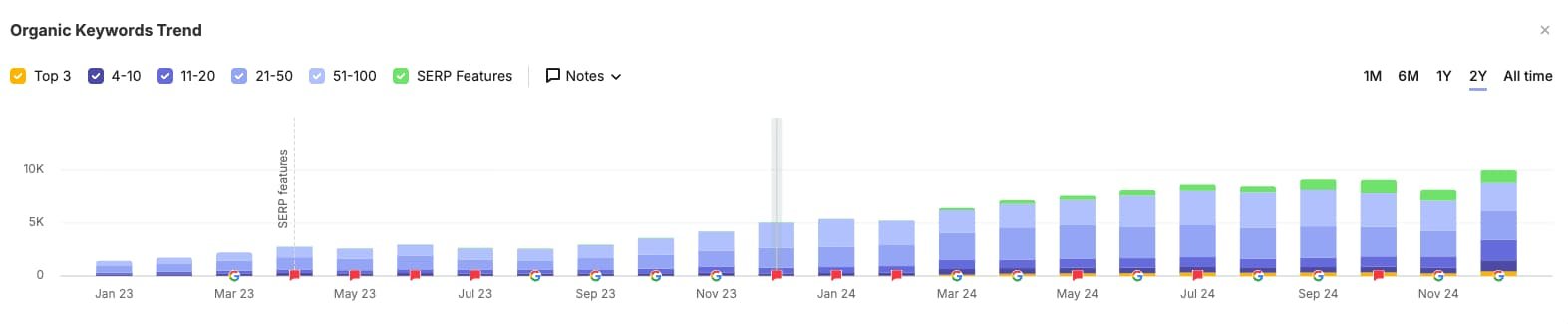
The avalanche strategy behind this engagement leaned heavily on long-tail keywords: lower-competition, more specific search terms that a new or lesser-known site can realistically rank for before it has the authority to compete on broad head terms. Winning that first wave of long-tail keyword opportunities is what allowed ranking keywords to grow from 176 to 9,983 and gradually built the topical authority needed to compete for more competitive terms later in the engagement.
Ranking Keywords: March 2022 → December 2024
Referring Domains: December 2021 → December 2024
Organic Traffic Growth: Frequently Asked Questions
What is organic traffic growth and why does it matter?
Organic traffic growth is the increase in visitors who find a site through unpaid search results rather than ads. It matters because it compounds: unlike paid traffic, which stops the moment spend stops, organic visibility keeps delivering visitors for as long as the content keeps ranking. On this account, 99.7% of traffic at the end of the engagement was non-branded, meaning it was real demand generation rather than people already searching for the company by name.
How long does organic traffic growth take for a niche or unfamiliar product?
When a product creates very little existing search demand, as this predictive risk assessment tool did at the start, growth takes longer than for an established category because there’s no existing search volume to capture right away; the content has to build that demand alongside its rankings. This engagement took roughly two and a half years to go from under 100 monthly clicks to 34,281 organic visits/month, using an avalanche approach that started with attainable keywords and built toward more competitive ones.
Can you grow organic traffic without paid link building?
Yes, though it takes longer and depends on content that’s genuinely worth linking to. On this account, referring domains grew from 71 to 142, roughly doubling, with no active link-building program running during that period; the growth came from content earning links on its own rather than outreach.
What role does keyword research play in organic traffic growth?
Keyword research determines which opportunities are attainable now versus which require authority the site doesn’t have yet. Rather than chasing competitive head terms from day one, this engagement used an avalanche approach: winning lower-competition keyword opportunities first, then expanding into more competitive terms as the site’s topical authority grew, all briefed against real ranking data and competitive content analysis.
How do FAQ content and schema markup support organic traffic growth?
FAQ sections built around real People Also Ask questions and structured data (schema markup) give a site more ways to appear in the SERP beyond a standard blue link: as a featured answer, an AI Overview citation, or part of a Knowledge Panel. On this account, that work resulted in 9,874 keywords triggering a People Also Ask result and 4,372 keywords generating an AI Overview citation, alongside a Google Knowledge Panel.
How does organic traffic growth compare to paid search traffic?
Paid search stops delivering visitors the moment the budget stops; organic traffic keeps compounding as long as the content keeps ranking. By December 2024, this account’s organic visibility carried an equivalent paid-search value of $10,325, meaning that’s what the same volume of clicks would have cost to buy through ads, but that visibility didn’t require ongoing spend to maintain.
What role does content marketing play in organic traffic growth?
Content marketing is what gives a site something worth ranking and worth linking to. On this account, every page was built from competitive SEO data and real search intent rather than assumptions, and FAQ sections were written directly from Google’s People Also Ask results, which is part of why 9,874 keywords now trigger a People Also Ask result and 4,372 generate an AI Overview citation.
Why do long-tail keywords matter for organic traffic growth?
Long-tail keywords are lower-competition, more specific search terms that a site can realistically rank for before it has the authority to compete on broad head terms. This engagement’s avalanche approach targeted attainable long-tail opportunities first, which is what allowed ranking keywords to grow from 176 to 9,983 while gradually building the topical authority needed to win more competitive terms later on.
How is organic traffic growth measured and monitored?
Organic traffic growth is tracked through metrics like ranking keywords, non-branded traffic share, referring domains, and search-feature visibility (People Also Ask, AI Overviews, Knowledge Panels), verified against tools such as SEMrush and site analytics. On this account, those metrics were tracked from a March 2022 baseline of 176 ranking keywords through December 2024, when verified SEMrush and site metrics showed 9,983 ranking keywords and 34,281 organic visits a month.
Need ongoing, hands-on SEO management instead?
My agency, Lift SEO Services, handles full-service SEO for healthcare and home services businesses in Bowling Green and Nashville: technical, local, content, and AI-visibility work, managed end to end.
Let’s build an SEO strategy that doesn’t depend on hiring a full-time team.
Book a free 30-minute strategy call: no pitch, just a look at where your SEO stands today.